 by husamkaloti
A New Stage Adaptation by The Freedom Theatre
In cooperation with the Consulate General of France in Jerusalem
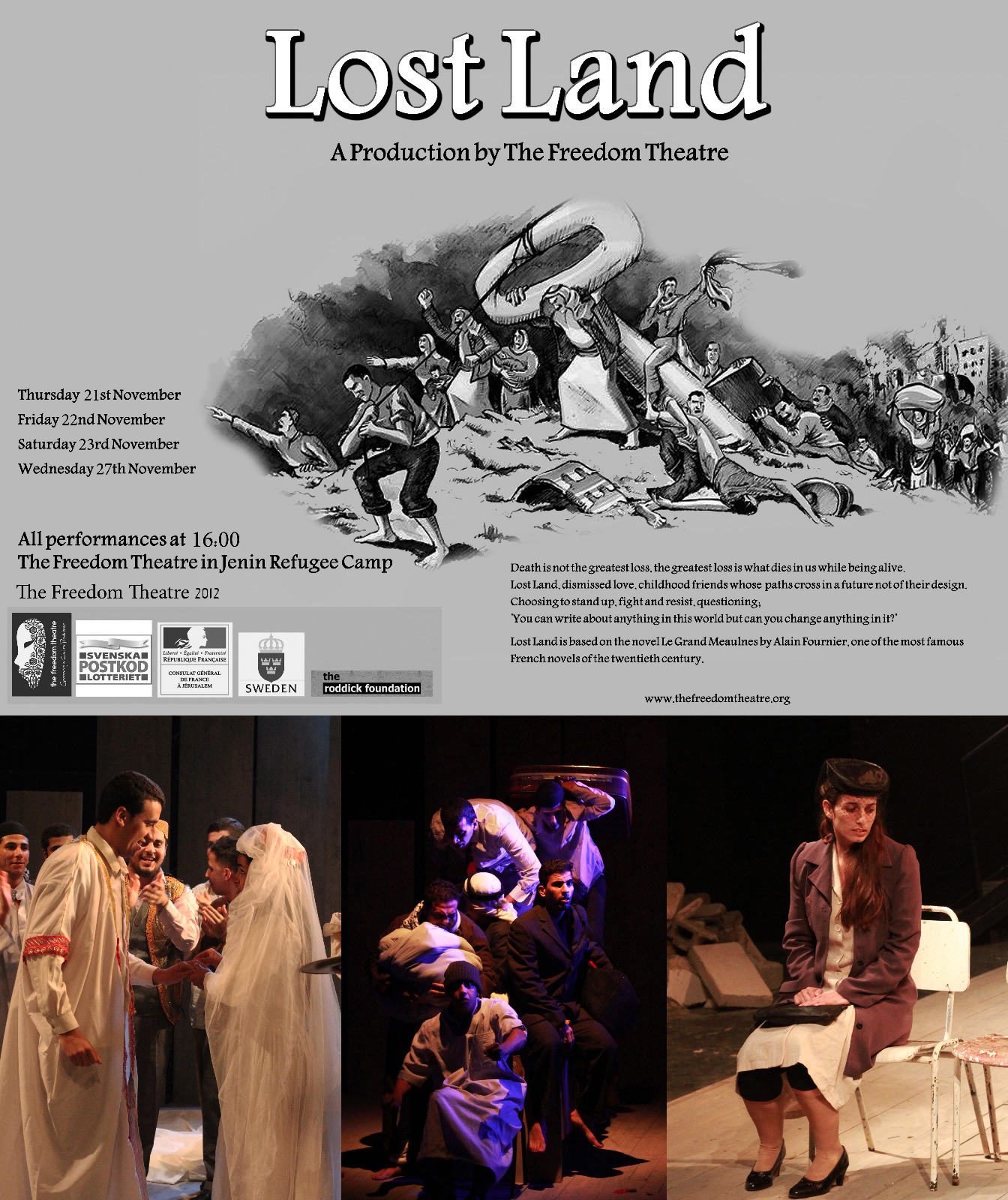
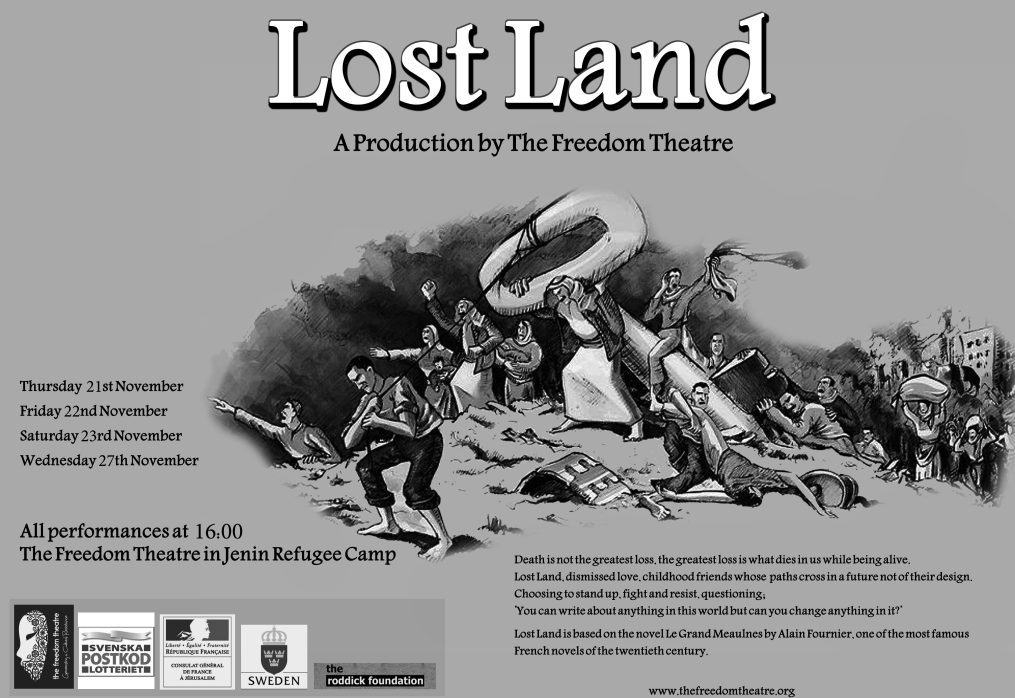
World Premiere: November 21–23 & 27, 2013 — The Freedom Theatre, Jenin Refugee Camp
Production Highlights
A quick snapshot of what defines this production at a glance:
-
Based on Le Grand Meaulnes by Alain-Fournier
-
Three generations of Acting School students performing together
-
Two-act large-scale staging
-
13 actors and multi-role ensemble
-
Performed in Arabic
-
Opening night attendance: 277 audience members, theatre at full capacity
Overview
Lost Land is a sweeping, dreamlike stage adaptation inspired by Alain-Fournier’s Le Grand Meaulnes, reimagined through the lens of Palestinian history, memory, and generational longing.
This major production brought together three generations of The Freedom Theatre’s Acting School, marking a decisive artistic milestone for the institution.
At its core, Lost Land explores an ache shared across time:
the search for what has been taken, the persistence of beauty in the midst of rupture, and the cost of coming-of-age in a world shaped by political upheaval.
Set in a landscape where personal destiny collides with collective struggle, the play follows a circle of young dreamers whose lives are broken apart and rewoven by love, war, and the irreversible tides of history.
The result is a theatrical experience that is intimate yet epic, nostalgic yet fiercely contemporary.
Why Watch Lost Land?
-
A rare Palestinian adaptation of a towering 20th-century French classic.
-
A coming-of-age tale set against the seismic historical shifts that shaped modern Palestine.
-
A visually rich production combining movement, music, and multi-role performance.
-
A story of youth, longing, first love, and the moments that define a generation.
-
A landmark artistic moment: three graduating classes of The Freedom Theatre working together on one stage.
⭐ Director’s Note
Lost Land asks a simple but devastating question: what remains after the world we know disappears?
This production is an invitation to revisit memory, personal, political, imagined, and to confront the fragile beauty of what we lose before we understand its value.
Artistic Vision
The Freedom Theatre reframes Fournier’s novel within a specifically Palestinian experience, transforming the book’s “lost domain” into an echo of uprooted villages, vanished childhood landscapes, and fractured memories.
The creative vision approached the material through three guiding ideas:
1- The Lost Paradise
A world glimpsed once, through love, beauty, or fleeting youth, and never found again.
2- The Burden of History
Ordinary young people forced into extraordinary choices simply because of the era they were born into.
3- The Persistence of Hope
Even in devastation, acts of love and resistance give meaning to what remains.
The staging blended naturalistic scenes with stylized physicality, creating a world shifting between memory, myth, and lived history.
⭐ Creative Context
By situating the novel’s symbolic “lost domain” in pre-1948 Palestine, the adaptation uncovers parallels between European literary myth and Palestinian lived reality, drawing a powerful line between universal longing and historical dispossession.
Synopsis
ACT ONE
Francis, an aspiring young writer, forms an immediate bond with Momin el Kbeer, a charismatic rebel whose appetite for adventure constantly lands him in trouble. After stealing a horse and cart, Momin wanders into unfamiliar territory and discovers a half-ruined Ottoman mansion hosting an extravagant wedding celebration.
There he encounters:
-
masked performers
-
children in fantastical costumes
-
music, dance, and spectacle
-
and Navine, the mysterious girl who enchants him at first sight.
But the celebration collapses abruptly:
Mohammed Jamjoon, son of the house, is abandoned by his Jewish-French fiancée Valentine just as the British Mandate crumbles and Palestine descends toward conflict.
Uprooted and consumed by longing, Momin returns home determined to find his way back to the “lost land” he briefly entered, a place that exists nowhere on any map.
His path crosses again with Jamjoon, now disguised as a performer and recruiting young fighters. He hands Momin Navine’s address in Beirut, asking only for a vow:
One day, join the struggle.
Momin sets off once more, another journey, another disappearance.
ACT TWO
In Beirut, Momin searches for Navine but instead meets a sympathetic French woman who has suffered her own heartbreak. Their brief romance shatters when he discovers her identity: she is Valentine, Jamjoon’s former fiancée. Believing he has been deceived, he reacts violently and abandons her.
Meanwhile, Francis, now a teacher in a refugee camp, finds Navine living in poverty with her father.
In Jerusalem, Momin learns that Valentine has joined the Palestinian resistance, and his old friends are now committed to the political struggle. Filled with remorse, he resolves to reunite her with Jamjoon, even briefly.
Momin and Navine are finally reunited and married. But their joy is short-lived: he answers Jamjoon’s call to arms and disappears again.
He returns one stormy night to find:
-
his newborn daughter in Francis’ arms
-
Navine dead in childbirth
-
an uprising sweeping the land
Momin and his childhood companions join the revolt.
Amid the ruins, only one thing survives:
Francis’ book; the story of the Lost Land.
Cast
Principal Roles
- Ahmed Al-Rokh – Francis
- Faisal Abu Al-heja – Momin el Kbeer
- Lamis Ammar – Navine Almasri
- Saber Shreim – Mohammed Jamjoon Almasri
- Micaela Miranda – Valentine / Ms. Sorrell / Biroo
Supporting Ensemble
Alaa Shehada
Gráinnemir Abu Al-Rob
Anas Arqawi
Awad Ghannam
Hala Farahat
Malak Al-Sadi
Motaz Malhees
Samah Mahmoud
Creative Team
Artistic Director: Nabeel Al-Raee
Movement Director: Micaela Miranda
Director’s Assistant: Qais Al-Sadi
Executive Producer: Jameyla Kiswani
Lighting: Mohammed Al-Sadi
Sound: Sami Al-Sadi
Stage Carpentry: Ahmad Matahen
Technical & Logistics Manager: Adnan Naghnaghia
Props & Costumes: Alia Al-Rosan
Publicity Design: Mohammed Moawia
Communications: Johanna Wallin
Script Translation: Fadi Abed Alkhaliq
Translation: Rewa’ Attiyeh
Production Stage Manager: Alan Wright
Assistants Stage Manager: Mohammed Yousef, Habeeb Al-Raee, Ibrahem Naghnaghia
Front of House: Kamal Awad
Resource Development: Katja Kumar
Producer: Jonatan Stanczak
The Freedom Theatre Production 2013
⭐ Production History
The premiere of Lost Land opened to 277 audience members, the theatre at full capacity, with many more turned away at the door. The production quickly drew audiences from Jenin, surrounding West Bank cities, and communities inside Palestine ’48. Special performances were later scheduled for local schools.
⭐ Audience Response
A selection of audience impressions:
- “One of The Freedom Theatre’s most ambitious works, emotionally overwhelming.”
- “Epic in scale, intimate in feeling.”
- “A haunting reflection of youth caught in the currents of history.”
Performance Details
Premiere Run:
November 21, 22, 23 & 27, 2013
Time: 16:00
Venue: The Freedom Theatre – Jenin Refugee Camp
Admission free; early arrival recommended.
⭐ Content Advisory
This performance includes themes of war, displacement, loss, and historical violence.
Support
This production was supported by:
The Swedish Postcode Lottery, The Consulate General of France in Jerusalem, The Roddick Foundation, and Sida (as part of PPAN).
Presented with appreciation for their commitment to cultural and artistic development in Palestine.
Archival Note
This publication serves as the official English documentation of Lost Land, preserving its artistic, historical, and educational value.
The production remains a landmark in The Freedom Theatre’s evolution, a moment when its creative community achieved the scale, depth, and ambition to reimagine a major literary work through a distinctly Palestinian lens.